
Reframing A Founder: A Long-Overdue Look at Gorky through the Lens of Community and Armenian Identity
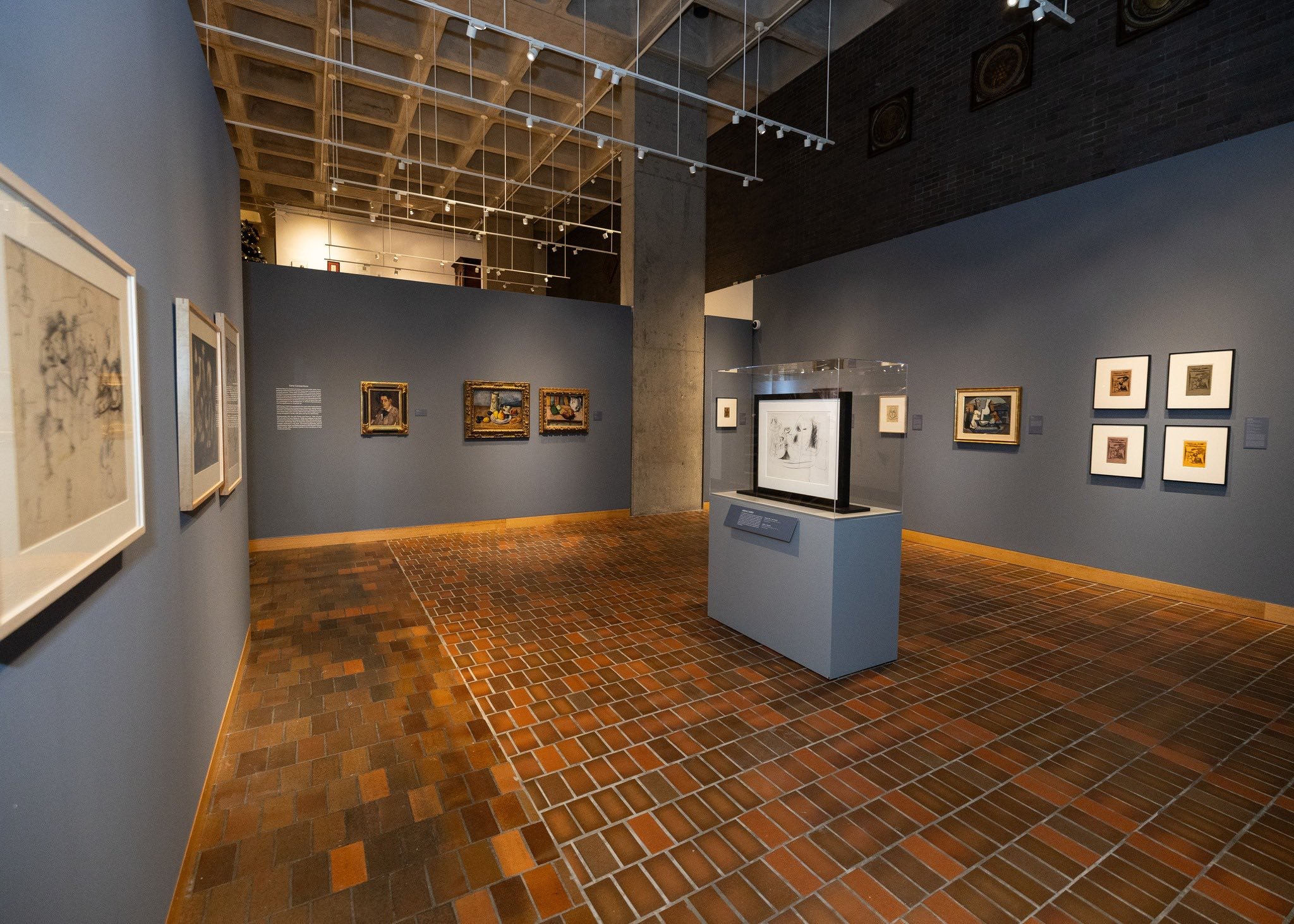
Installation photograph by Natalie Nigito. (c) 2026 The Arshile Gorky Foundation / Artists Rights Society (ARS), New York.
By James Dyment
Artscope Magazine
March/April 2026
Created for inclusion in the citywide “100 Years of Arshile Gorky” centennial celebration in Watertown, Massachusetts, “Redrawing Community & Connections” at the Armenian Museum of America is an exhibit highlighting the work of Armenian-American artist Arshile Gorky.
Gorky, born Vostanik Manoug Adoian, is known for the birth of Abstract Expressionism in the United States. But not everyone knows that he was an Armenian artist. Immigrants who fled the genocide in Armenia settled in Watertown in the early 1900s and many worked at Hood Rubber Company, including Gorky.
And what makes this exhibition even more notable? “This exhibit was a lot of firsts for our community and the Armenian Museum of America (AMA), including this being the first exhibit of Gorky’s work in an Armenian museum anywhere in the world,” said Jason Sohigian, AMA Executive Director.
Sohigian explained that the show is curated by Kim Theriault, author of “Rethinking Arshile Gorky.” She brings a unique approach to Gorky by highlighting him as an Armenian artist, something that often is missed.
Twenty-six items from 15 lenders are displayed. “The museum received support from the Arshile Gorky Foundation in reaching out to potential lenders in New England, New York and California. The works are rarely seen since they are from private collections. These include collectors in Connecticut and Massachusetts, where many had ties with the Gorky Family,” Sohigian said. “Also included is the Eastern Diocese of the Armenian Church of America based in New York, which has a collection that is not widely exhibited.”
“AMA Development Director Sarah Hayes played a key role in the acquisition of the loans,” added Sohigian.
“Kim Theriault wove a compelling narrative around the 26 works which are reflected in the wall text and the gallery guide,” said Sohigian. The title of the show, “Redrawing Community and Connections,” alludes to the friends and family who were often the subjects of his art as well as the artists Gorky admired and engaged with on his journey.
The painting that first caught my attention was “Self-Portrait 1923-24,” an oil on canvas board. It’s painted with thick layers of paint in shades of brown and taupe. Gorky is dressed in a jacket with a black tie. A dark shadow cast on the right side of his face brings a feeling of loneliness and silence. He was only about 19 or 20 years old at the time.
As I walked through the gallery, I made note of works from various points on Gorky’s timeline. Several imitate the style of fellow artists, which was common as he
gradually created his own.
“Still Life with Pitcher and Pears,” c. 1926-27, an oil on canvas, is reminiscent of Paul
Cézanne’s still-lifes. Ripe pears, plums, a lemon and a peach are positioned on a wooden table — a classic composition. Another one, “Still Life with a Pitcher,” c. 1928-29, shows a reference to Pablo Picasso.
A small pencil drawing of a woman’s face draped in a headscarf, “Study for Mother and Son,” c. 1936 is on loan from the Whitney Museum of American Art, New York. It was based on a photograph taken in Armenia in 1912. Gorky’s mother starved while making sure her son survived. She never made it to the United States.
A grouping of Christmas cards in various colors (orange, lavender and brown) are printed with a linocut abstract figure — a nod to Joan Miró, an artist who heavily influenced Gorky. Three are on loan from the Diocese of the Armenian Church of America (Eastern), and three were a gift from Andrea and Katherine Balian.
A pair of portraits are displayed together. On the left is “Portrait of Arshile Gorky,” c.1940s, an oil painting by Saul Schary, on loan from collector James Melikian. It’s a caricature and Gorky’s hands are large, which makes them come forward in the composition. On the right is a pencil drawing done by Gorky, “Portrait of Saul Schary,” c. 1938, which is on loan from Blair and Paul Resika.
Another painting, “Portrait of Arshile Gorky,” 1930, rendered in ink, watercolor and pencil by Ukrainian-Russian immigrant David Burliuk is on loan from the Whitney Museum of American Art, New York.
Three abstract drawings stand out because their style is related to the paintings Gorky is known for, Abstract Expressionism. “Drawing, Pastoral,” c. 1946, is a combination of ink wash, pastel and graphite pencil on paper. “The Betrothal, Motif,” c. 1946, and “Untitled,” c. 1944-45, were both drawn with graphite pencil and crayon on paper. All three display abstract shapes and appear to be studies for larger paintings. They are on loan from a private collection, courtesy of Betty Krulik Fine Art, Ltd. New York.
A dark room [The Rose and Gregory Archie Kolligian Media Room] offers a place to sit. Here you can watch a continuous loop of “They Will Take My Island,” 2020, a musical documentary hybrid by filmmaker Atom Egoyan and composer/documentarian Mary Kouyoumdjian. It premiered at the Metropolitan Museum of Art in 2021. The film uses the 1944 painting, “They Will Take My Island” as a backdrop for the biography of Gorky. Footage from Egoyan’s film “Ararat” (2002) and “A Portrait of Arshile” (1995), a collaboration film with his wife Arsinée Khanjian, are used in the film.
The Armenian Museum of America is an amazing resource. It’s also a library and the largest Armenian museum in the Diaspora. It contains over 25,000 artifacts from Armenia including jewelry, pottery, coins and rugs. Upstairs is a fantastic black-and-white photography exhibit by photographer Yousuf Karsh which includes many celebrities such as: Winston Churchill, Eleanor Roosevelt and Ernest Hemingway. On Sundays, the lot behind the museum has free parking. It’s well worth the trip.
Click here to read more and subscribe to Artscope: artscopemagazine.com.