
Sound Archive
The following are selections from the museum's roughly 3,000 disc collection of early Armenian recordings and musical ephemera. Explore the links below to listen to songs, learn about pivotal musicians and see images of original records.
A special thanks to Jesse Kenas Collins, Harry Kezelian, and Harout Arakelian whose ongoing contributions of research and consultation have been critical to assembling the writings presented here.
A special thanks to the SJS Charitable Trust for their generous support of our work to digitize and share our collection of 78 rpm records.

A Souvenir: Lacquer Discs and the Armenian Argentine Story
Given the Museum’s location in the US, many of the recordings we have discussed in the Sound Archive represent the output of the Armenian American diaspora, but the nature of diaspora is inherently global and the unifying aspect of a common culture means that sometimes documents end up far from their place of origin. Today we present one such record that provides a window into the Armenian Argentine diaspora, as well as a special subcollection of non-commercial lacquer discs.

The Gomidas Band: Expanding Tradition
The post-WWII Armenian-American bands have been a recurring theme here at the Sound Archive. These sons of immigrants gave new impetus to the Armenian dance culture in the Diaspora by blending their Anatolian roots with the brash sounds of American jazz, giving rise to “kef music.”
This history is intertwined with the story of the Gomidas Band — which is largely the story of Henry “Hank” Mardigian. Mardigian was born and raised in Philadelphia to a family from Malatia. He first apprenticed under musician Sam Vosbikian as a fill-in banjo player and then saxophone player in the Vosbikian Band, while two of the members were off fighting in WWII. In 1949, he was approached by Johnny Kitabjian, a friend from AYF, to help him with a band he was forming. This band became the Gomidas Band.

Guy Chookoorian: Opening the door…
The Armenian Museum of America’s Sound Archive begins 2023 with a celebration of Guy Chookoorian’s fascinating and humorous musical contributions. Guy was a musician, singer, comedian, and actor. Proudly American, Guy served in World War II as a member of the 331st Bomb Squadron of the 94th Bomb Group, flying 32 missions over Europe. He was the son of heroic Genocide survivors from Yerzinga. Along with his sister Sue, Guy cofounded the Armenian-American Theater Group in Fresno in the mid-1940s. Even as he thrived in Hollywood, Guy would never forget his heritage. Celebrating Armenian culture throughout his entire career, he helped to preserve the folk songs of his native region.

Sound Archive 2022: Year in Review
As we enter the New Year, we’re taking a look back at the artists and topics covered in the Sound Archive posts since they began two years ago! We hope this overview helps emphasize the depth and richness of Armenian musical history encompassed in the collection. For half a century now, the Museum’s collection of 78rpm records has grown, thanks to generous donors who have been entrusting us with their personal collections. The diverse histories, taste, and experience of those donors is reflected in the recordings found in the collection, providing a rich pool of music to share and a wide range of stories through which we can explore Armenian culture and music.
We hope you enjoy the selections that we're shared so far. For those of you who may have missed previous posts or are just discovering the series, we encourage you to take a look back and explore previous sounds from our archives!

Hrand Markar Tashjian: The Early Days of Reissues
The Sound Archive presents digitized versions of 78 rpm records from our collection. This month we are featuring record distributor Hrand Markar Tashjian. Tashjian was a trailblazer, taking matters into his own hands when Armenian music was almost impossible to get your hands on in the 1940s and 50s. He reissued out of print recordings from major labels on a series of his own imprints.
This month's post includes four digitized and restored songs: Yaylouges Gorav, Siroung Groung, Amen Hayr Sourp, and Vart. Special thanks to the SJS Charitable Foundation for their generous support of our work to digitize and share our collection of 78 rpm records.
The Vosbikian Band: Pioneers of Armenian-American Culture
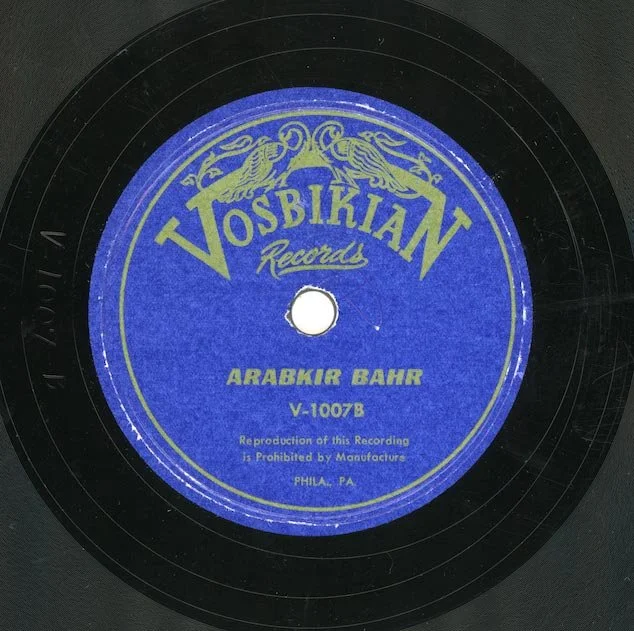
This Sound Archive highlights one of the most influential bands in the history of the Armenian community in America. Known and beloved by fans on the East Coast for generations, the Vosbikian Band was the first American-born Armenian dance band, raised outside of their parents’ historic homeland in Armenia and Asia Minor.
The Vosbikian Band started with three brothers, Sam (Sahag) Vosbikian (1919-2012), Mike (Manuel) Vosbikian (1921-2019), and Joe (Hovsep) Vosbikian (1924-2012). They were born in Philadelphia to Bedros and Vartanoush Vosbikian, who were natives of Malatia. Bedros was a clarinet player who performed with his brother Thomas on violin, with other friends and cousins providing vocals and dumbeg (hand drum) beats.

An Introduction to Armenian Soviet Recordings: Arev Baghdasaryan & Levon Madoyan
In this 18th Sound Archive post, we feature four songs by two highly accomplished musicians. Born in Shushi, Arev Baghdasaryan studied dance and music in Baku during the 1930’s. The arrangements of the folk songs “Garunkner'' and “Hayots Ashkharh'' feature her distinctive sound. The other two pieces, “Akh, Im Champen” (Ah, My road) and “Shirakskii Tanets” (Dance of Shirak) showcase an iconic Armenian instrument. On this Soviet 78 rpm record manufactured in Moscow, we hear the highly accomplished duduk player Levon Madoyan.

Souren Baronian: A Jazzman with an Armenian Swing
In post-World War II America, a generation of American born Armenians began recording music. In 1949, the Vosbikians and the Nor-Ikes would redefine Armenian music and create a cultural phenomenon. Other bands followed including the Gomidas Band, Aramite Band, the Orientals, the Ararat Band, and the Barsamian Orchestra. This profile of Souren Baronian is the beginning of a series of posts related to the young Armenian-American musicians.
Torcom Bezazian: The Prolific Baritone
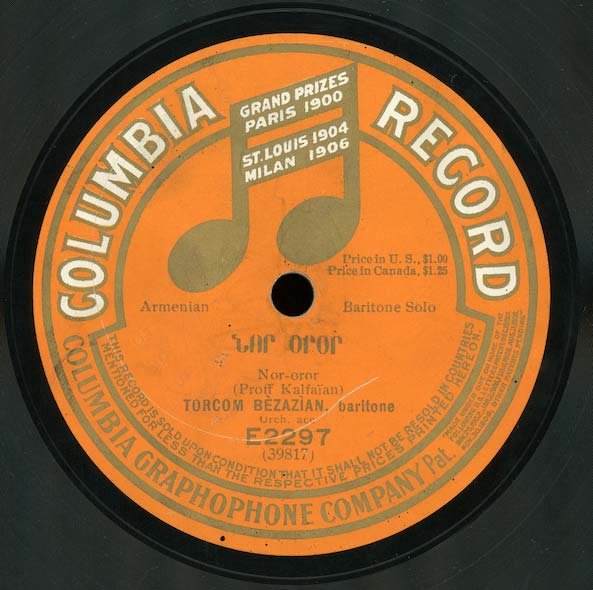
With a short yet colorful career in the United States of America, Torcom Bézazian can be considered the most prolific Armenian recording artist of the early 78 rpm era and the only Armenian to record with the three major labels of the era, Columbia, Victor and Edison. Born in Constantinople on September 23, 1889, Bezazian fled the Ottoman Empire and pursued an education in France where he graduated with a degree in engineering from the University of Nancy. Bezazian forsook his career in engineering, and began a serious study of music. Like Armenag Shah-Mouradian and Krikor Proff-Kalfaian, Bezazian studied with Vincent D’Indy. Torcom arrived in the United States in 1913 and over the next decade and a half the baritone enjoyed a successful career on the opera and vaudeville stages.